When divers in the Andaman Sea talk about wreck diving, the name Boonsung comes up almost immediately. This sunken tin dredger rests on the seabed approximately 20 kilometres off the coast of Khao Lak in Phang Nga Province, and has been quietly transforming into one of Thailand’s most beloved artificial reefs since it sank back in the 1980s.
The Boonsung was originally a working tin dredging vessel that operated throughout the Andaman region during an era when tin mining was a major industry along Thailand’s western coastline. After sinking, the rusting steel hull gradually became a foundation for an entirely new ecosystem — one that today supports hundreds of marine species and draws divers from every corner of the world.
What makes Boonsung truly special is the contrast between what it once was and what it has become. A working industrial vessel turned living underwater garden is a transformation that never fails to leave a strong impression on first-time visitors.
The Current State of the Wreck: What Is Left to Explore
The Boonsung Wreck lies at a depth of approximately 18–22 metres, with the structure spread across the sandy seabed in several sections due to decades of natural deterioration. Unlike some wreck dive sites where the vessel remains largely intact, Boonsung has broken apart and flattened over time — and this is precisely what gives it a character all its own.
Key sections that remain recognisable and worth exploring include:
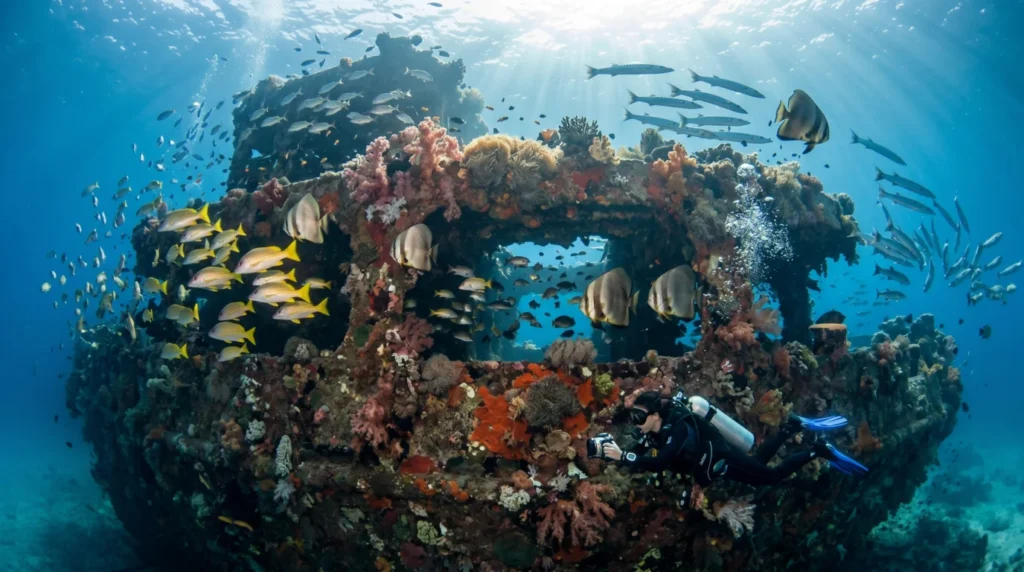
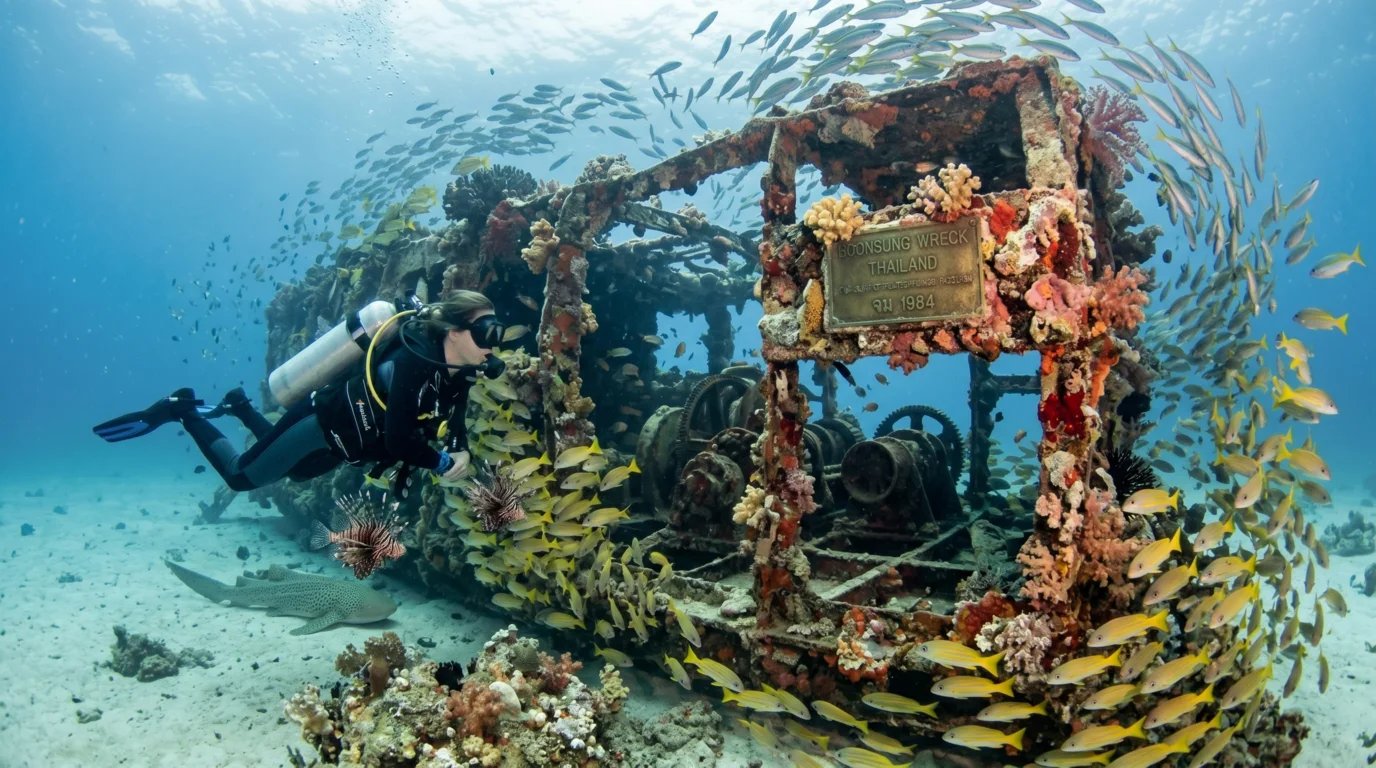
- Large steel framework completely encrusted with vivid orange and red soft corals
- Pipes and dredging machinery that now serve as shelter for countless fish species
- The engine room area where the outline of the original vessel is still visible
- Layered structural sections that create interesting photographic compositions from multiple angles
The wreck’s spread-out layout actually works in divers’ favour, as it allows for relaxed exploration without the need to navigate tight enclosed spaces — making it accessible to a much wider range of experience levels.
Marine Life at Boonsung: Who Lives in This Underwater World
The biodiversity surrounding Boonsung Wreck is what truly elevates it beyond a simple historical curiosity. The steel structure and surrounding sandy bottom support an impressive variety of marine life throughout the year. Regular sightings include:
- Lionfish — tucked into steel crevices and almost impossibly well-camouflaged
- Scorpionfish — blending seamlessly into the coral-covered surfaces
- Moray eels — poking their heads out from gaps in the metalwork
- Grouper — circling the structure in loose groups
- Octopus and squid — particularly active after dark
- Starfish and sea urchins — scattered across the sandy floor surrounding the wreck
- Nudibranchs — a macro photographer’s dream hiding in plain sight
The soft corals that have colonised the steel frame are a highlight in their own right. Orange sea fans and delicate coral formations catch the light beautifully and create the kind of imagery that ends up on diving magazine covers. For divers interested in exploring more of the region’s remarkable marine megafauna, Koh Bon and Koh Tachai: Paradise for Manta Rays and Whale Sharks is well worth reading before planning your trip.
Difficulty Level: Is This Dive Site Really for Everyone
One of Boonsung’s greatest strengths is its accessibility. With a maximum depth of around 22 metres and generally mild currents for most of the year, this wreck welcomes divers across a broad spectrum of experience. It works well for:
- Newly certified Open Water divers looking for their first wreck experience
- Intermediate divers wanting to practise underwater photography in an interesting environment
- Experienced divers who want to focus on macro life and detailed exploration
The main variable to be aware of is visibility, which can shift considerably depending on season, rainfall, and tidal movement. Average visibility sits between 5 and 15 metres — noticeably less than sites in the Similan Islands, but more than sufficient for a thorough and rewarding dive around the wreck structure.
Night Diving at Boonsung: A Completely Different World After Dark
If the daytime dive at Boonsung is impressive, the Night Dive is transformative. Once the sun disappears, an entirely different cast of characters emerges from the wreck and surrounding seabed.
Squid and octopus hunt actively along the steel framework. Crabs and shrimps of various species venture out across the sand. Fish that stay hidden during daylight hours become visible and approachable. And perhaps most spectacularly, the soft corals open their polyps fully in the darkness — illuminated by a dive torch, they resemble a garden of living flowers in a way that photographs simply cannot do justice.
Night diving at Boonsung is one of the most consistently recommended experiences among Khao Lak’s dive operators, and suits any diver who has completed at least a few night dives previously and feels comfortable navigating with a torch.
Getting to Boonsung Wreck: Closer Than You Might Expect
One of Boonsung’s practical advantages over Similan Islands dive sites is its proximity to shore. A boat from Khao Lak’s main pier reaches the wreck in approximately 45–60 minutes, making it an ideal day trip option that doesn’t require an early pre-dawn departure or an overnight liveaboard commitment.
Common ways to visit the site include:
- Day Trip — depart in the morning, complete 2–3 dives, return to shore by afternoon; the most convenient and cost-effective option
- Combined with nearby sites — many operators pair Boonsung with Koh Dok Mai or Koh Waen to offer varied environments within a single day on the water
For divers looking to plan a complete Khao Lak diving experience with professional guidance and local expertise, visit King Andaman Scuba Diving Khao Lak for packages and schedules.
Underwater Photography at Boonsung: Where to Find the Best Shots
Boonsung Wreck has earned a strong reputation among underwater photographers, and for good reason. The combination of structural scale, colour from the soft corals, and the diversity of marine behaviour creates an environment where compelling images are possible at every turn.
Angles and subjects that consistently produce strong results:
- Shooting upward from below the steel frame with sunlight filtering through soft corals as natural backlighting
- Close-up portraits of lionfish and scorpionfish, which hold their position and rarely retreat from a camera
- Wide-angle compositions of the wreck structure during peak visibility with good ambient light
- Night shooting with a strobe to bring out the true colours of fully open soft coral polyps
A camera capable of good macro performance is particularly valuable here, given the density of nudibranchs, shrimps, and other small creatures found throughout the wreck.
Comparing Boonsung to Other Khao Lak Dive Sites
Khao Lak offers several distinct dive environments, each with its own appeal. Boonsung stands apart through its combination of history, structure, and the particular atmosphere that only a wreck dive can provide. Koh Dok Mai, by contrast, offers dramatic limestone walls and hard coral formations. Koh Waen delivers more open-water reef diving with different species composition.
For divers who want to experience both wreck diving and the natural reef environments that Khao Lak has to offer, combining Boonsung with one of the island sites in a multi-day trip is an approach that most instructors and guides recommend. Divers interested in developing their skills further can explore course options at Scuba Diving Courses at Khao Lak with King Andaman Scuba.
Best Time of Year to Dive Boonsung Wreck
A significant advantage that Boonsung holds over the Similan Islands is year-round accessibility. While Similan operates on a seasonal basis, Boonsung can be dived throughout most of the calendar. That said, conditions do vary considerably:
- November – April — best visibility, calmest seas, ideal for photography and all experience levels
- May – October — monsoon season brings rougher surface conditions and reduced visibility, though diving is still possible on good weather days
Safety and Precautions for Wreck Diving at Boonsung
Wreck diving carries specific considerations that differ from open reef diving. Boonsung is among the safer wreck sites in the region, but a few points deserve attention regardless of experience level:
- Avoid inserting hands or body into enclosed sections of the structure without proper wreck penetration training
- Be mindful of silt disturbance near the wreck surface, which can reduce visibility rapidly
- Monitor air supply carefully, especially when exploring lower-light areas of the structure
- Always dive with a guide who knows the site, as the wreck’s layout continues to change gradually over time
For information on marine conservation regulations and responsible diving practices in Thai waters, the Department of Marine and Coastal Resources provides official guidance on protected areas and environmental responsibilities.
Summary: Why Boonsung Wreck Belongs on Every Khao Lak Dive List
To sum up, Boonsung Wreck is far more than an old sunken boat. It is a living ecosystem, a piece of regional history, and one of the most reliably rewarding dive sites along Thailand’s Andaman coastline — all within an hour of the shore.
Whether you are a newly certified diver ticking off your first wreck, a photographer hunting for that perfect soft coral composition, or an experienced diver ready to explore after dark, Boonsung delivers something worth coming back for. Few dive sites manage to be simultaneously accessible to beginners and genuinely interesting to veterans, and that quality is precisely what has kept Boonsung’s reputation intact for decades and counting.
Frequently Asked Questions
Q: Is Boonsung Wreck suitable for beginner divers?
A: Yes — with a maximum depth of 22 metres and generally calm conditions, it’s one of the most beginner-friendly wreck dives in the Andaman Sea.
Q: What is the visibility like at Boonsung?
A: Typically 5–15 metres depending on season. November through April offers the clearest water.
Q: Can you night dive at Boonsung Wreck?
A: Absolutely, and it’s highly recommended. The wreck comes alive after dark with squid, octopus, and fully open soft corals.
Q: How long does it take to reach Boonsung from Khao Lak?
A: Around 45–60 minutes by boat — making it one of the most conveniently located dive sites in the area.