In diving, enjoyment and safety are not in competition with each other. They are inseparable, and any operation that treats them as separate concerns has fundamentally misunderstood what responsible dive management requires. At King Andaman Scuba, based in Khao Lak, Phang Nga Province, this principle sits at the centre of every decision made — whether the trip in question is a day excursion to the Similan Islands, a beginner’s first pool session, or a multi-day liveaboard covering the full length of the Andaman archipelago.
Diving safety in its complete sense encompasses far more than having the right equipment on board. It extends across every dimension of the operation: the selection and ongoing training of guides, the systematic inspection of every piece of equipment before use, the reading of weather and sea conditions before departure, and the maintenance of clear, rehearsed emergency protocols for situations that nobody hopes will arise but that a responsible operator is always prepared to handle. This article examines how King Andaman Scuba approaches each of these areas, and why the details matter considerably more than most divers realise before they book.
Dive Guides: The People You Need to Trust Completely Underwater
The quality of any diving experience depends substantially on the person leading it. King Andaman Scuba places significant emphasis on the selection and ongoing development of its guide team, holding to standards that exceed the baseline requirements common across the industry.
Every guide operating with King Andaman Scuba holds a minimum certification of Divemaster or above from a recognised international diving organisation, carries current First Aid and Emergency Oxygen Provider qualifications, and has accumulated meaningful in-water experience specifically in the waters of Khao Lak and the Similan Islands — including familiarity with local current patterns, site-specific navigation, and the seasonal behaviour of marine species throughout the area.
Technical qualification alone, however, does not define a capable dive guide. King Andaman Scuba’s guides receive training in the observation of diver behaviour underwater — learning to read the signs that indicate someone is struggling before the situation escalates, and to make fast, correct decisions under pressure. The ability to remain calm and effective in a difficult situation is not something that can be acquired from a manual; it develops through experience, repetition, and a culture within the team that takes these responsibilities seriously every single day.
Equipment: Checked Before Every Trip, Without Exception
Equipment failure underwater is not a theoretical inconvenience — it is a genuine emergency. King Andaman Scuba applies a structured equipment inspection process before every trip and before every individual dive, with no shortcuts taken regardless of how routine a particular outing may appear.
The inspection process covers:
- BCD and regulator — full operational check of all components before a diver puts the equipment on, including testing of the inflator, dump valves, and octopus regulator
- Cylinders — pressure and air quality verified against standard thresholds; no cylinder below the minimum pressure threshold enters the water
- Wetsuits and fins — checked for correct sizing and condition before being issued to each diver
- Safety equipment — SMBs, torches, and emergency signalling devices confirmed ready for use on every dive
Equipment maintenance follows a scheduled cycle rather than a reactive one. Waiting for a problem to appear before addressing it is not an acceptable approach when the consequences of failure occur 20 metres below the surface. The discipline of preventive maintenance is what keeps the failure rate close to zero — and close to zero is the only target worth setting.
The Dive Briefing: Information That Can Genuinely Save Lives
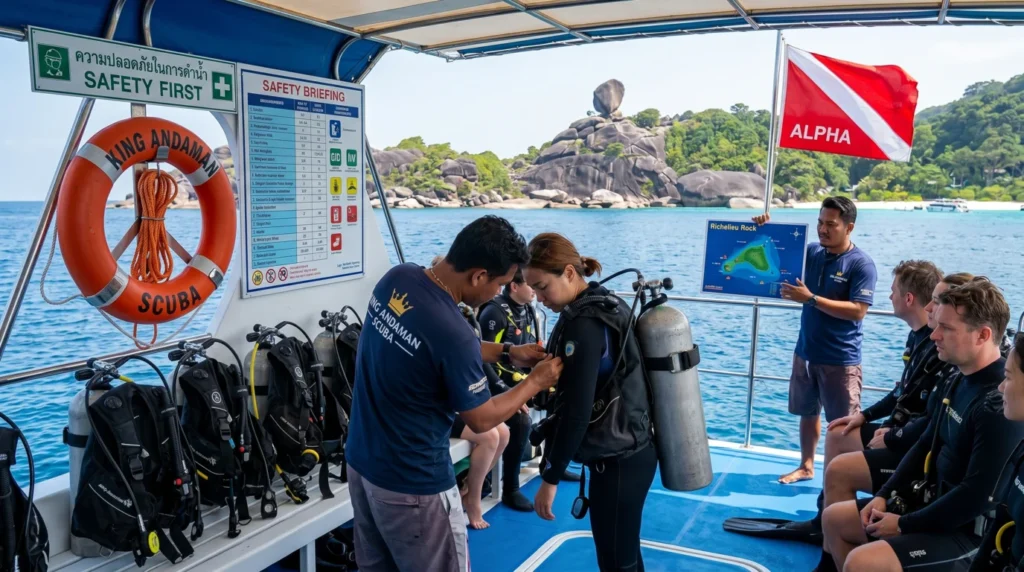
The pre-dive briefing is one of the steps that newer divers most commonly underestimate. It can feel like a formality — a box to tick before the actual experience begins. At King Andaman Scuba, it is treated as one of the most important parts of the entire dive, and it receives the time and attention that importance demands.
A standard briefing covers the specific dive site for that session — its depth profile, current conditions, known hazards, and any features requiring particular attention. It establishes the hand signals that will be used for communication underwater, reviews the plan for managing separation from the group, sets the agreed maximum depth and bottom time for the dive, and confirms the conservation rules that apply throughout.
A thorough briefing means that every diver in the group enters the water with the same understanding of the plan, the same awareness of what to do if something changes, and the same vocabulary for communicating underwater. This shared knowledge is the practical foundation of safe group diving, and no amount of experience makes it redundant.
Guide-to-Diver Ratios: A Number That Matters More Than Most People Ask
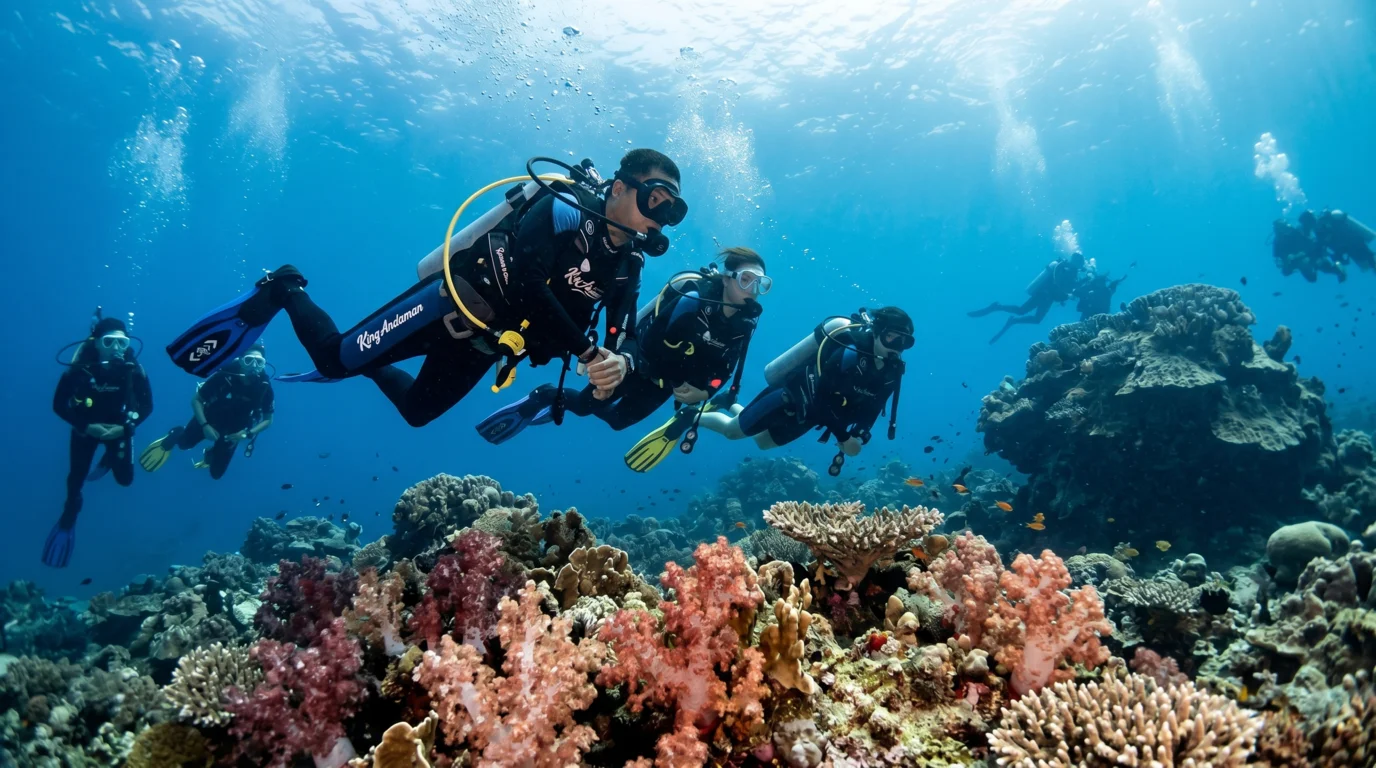
The ratio of guides to divers is one of the most direct determinants of safety in a dive group, and it is one of the questions that most divers do not think to ask before booking. King Andaman Scuba maintains strict control over this ratio, with the guiding principle that every guide must be genuinely able to monitor every diver in their group throughout the entire dive.
The standard maximum ratio is one guide to four divers for typical recreational groups. This reduces to one-to-two or one-to-one for divers with limited experience, for children, or for dives in more technically demanding environments — such as the granite tunnel system at Elephant Head Rock or sites where strong and variable currents require more active management of the group.
A guide managing a group of eight divers cannot simultaneously maintain awareness of all eight individuals. A guide managing four can. This is not a subtle difference — it is the difference between a guide who is genuinely supervising and a guide who is hoping nothing goes wrong at the back of the group.
Reading Sea and Weather Conditions: The Decision Made Before Departure
The ocean is not a static environment, and conditions that appear manageable at departure can shift considerably once a vessel is an hour offshore. King Andaman Scuba applies a daily assessment process for sea and weather conditions before any trip departs, drawing on multiple information sources to build the most accurate picture possible.
This process includes reviewing weather forecasts from several sources, monitoring current and swell data specific to the planned dive sites, and communicating with vessels and operators already in the area to obtain real-time conditions from the water itself rather than relying on forecasts alone.
When conditions at a planned site are assessed as unsuitable for safe diving, King Andaman Scuba adjusts the programme or cancels the trip. This decision is made without negotiation. No commercial consideration changes the outcome when the assessment is clear. The consistency of this approach is what makes it meaningful — a policy that bends under pressure is not a safety policy, it is a suggestion.
Emergency Protocols: Prepared for What Nobody Hopes Will Happen
Having a clear emergency plan is not a pessimistic act. It is the most practical expression of taking safety seriously. King Andaman Scuba maintains emergency protocols that are rehearsed regularly, understood by every member of the team, and executable without delay when needed.
Emergency equipment carried on every vessel includes:
- A fully stocked and current first aid kit
- Emergency oxygen for initial management of decompression sickness symptoms
- Marine communication equipment for contacting rescue services and medical facilities
- A documented plan for patient transfer to the nearest hyperbaric chamber, with contact information maintained and verified
Every team member knows their specific role in an emergency scenario. There is no time in a genuine emergency to assign tasks or seek instructions. The speed and effectiveness of a response in the first minutes after an incident determines outcomes, and that speed only comes from preparation that happened long before the emergency occurred.
For comprehensive background on the physiological principles underlying diving safety and the international standards that govern recreational diving, the Recreational Diving — Wikipedia article provides a well-organised reference covering the full scope of established safety practice.
Responsible Diving: The Safety of the Ocean Is the Safety of Everyone
The safety framework at King Andaman Scuba extends beyond the wellbeing of the divers on board. The marine ecosystem that every diver visits is itself something that requires active protection, and the way a dive is conducted determines whether that visit leaves the environment better, unchanged, or worse than it was before.
The principles applied on every trip are consistent and non-negotiable:
- No touching or standing on any coral formation under any circumstances
- No feeding of marine animals, which disrupts natural behaviour and creates dependency
- No collection or removal of any living or non-living material from the dive site
- Full compliance with all national park regulations in every area visited
These are not rules applied only when an inspector might be watching. They reflect a straightforward understanding that the quality of diving available in the Andaman Sea depends directly on the health of the ecosystem being dived, and that health is maintained or damaged by the cumulative effect of individual choices made on every dive, every day, by every operator working in the area.
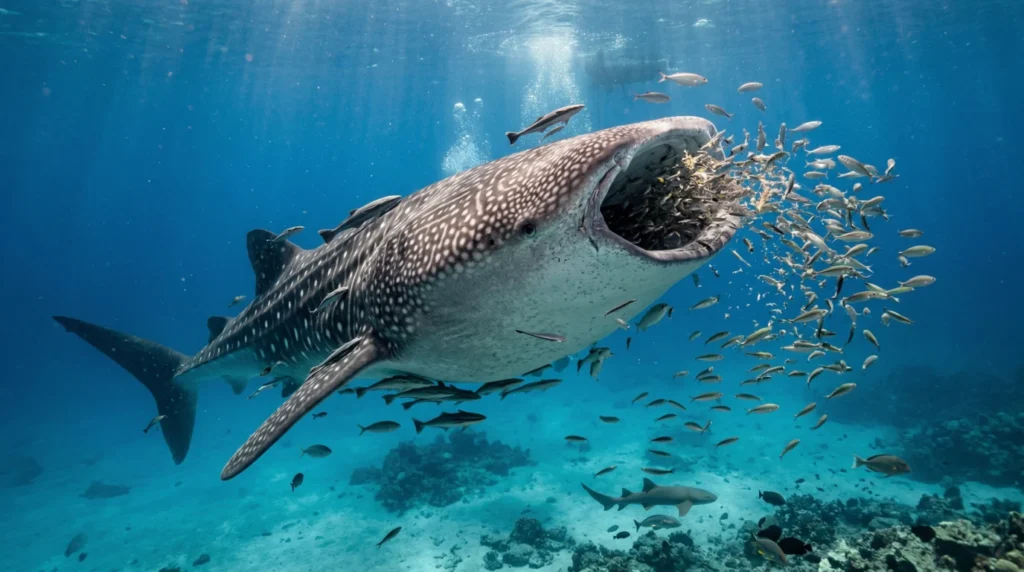
Divers interested in understanding more about one of the Andaman Sea’s most iconic marine species — and how to behave appropriately when an encounter occurs — will find Fascinating Whale Shark Behaviour worth reading before their trip.
Certifications and International Standards: The Verifiable Guarantee
In the diving industry, certification from a recognised international organisation is the tangible evidence that a guide or instructor has met a defined standard of knowledge and practical skill. It is not a sufficient condition for excellence on its own, but it is a necessary baseline — and it is one that King Andaman Scuba requires of every guide and instructor operating under its name.
Certification means that an individual has demonstrated underwater rescue skills in real conditions, passed written assessments on diving physics and physiology, and completed a supervised period of practical guiding under evaluation. These requirements exist because the consequences of inadequate preparation in a diving context are not comparable to those in most other recreational industries.
For a thorough overview of how scuba diving safety principles are defined and applied internationally, the Scuba diving — Wikipedia article covers the technical and procedural foundations that underpin professional standards across the industry.
How to Prepare as a Diver: Your Role in Your Own Safety
Safety in diving is a shared responsibility. The operator’s role is to create the conditions for a safe dive. The diver’s role is to enter those conditions honestly and prepared. King Andaman Scuba asks every diver to take the following steps seriously before arriving for any trip:
- Disclose all relevant medical history accurately and completely, particularly any history of heart or lung conditions, recent surgery, or pregnancy. The medical questionnaire is not a formality.
- Arrive adequately rested. Fatigue measurably impairs judgment and physical response underwater.
- Avoid alcohol for a minimum of 12 hours before diving. Alcohol affects both judgment and the body’s management of nitrogen at depth.
- Arrive well hydrated. Dehydration is a recognised contributing factor in decompression sickness.
- Communicate with your guide immediately if you feel unwell, anxious, or uncertain at any point during the dive. No guide will judge that conversation. Every guide will respect it.
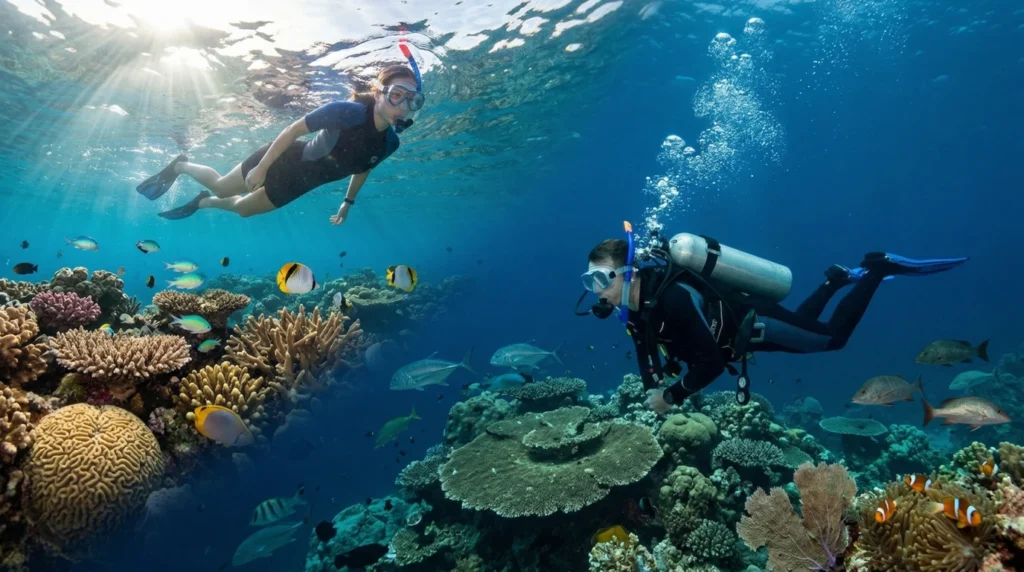
Divers who want to build a stronger understanding of what different diving environments actually involve before their first open-water experience will find the article Scuba Diving vs Snorkelling — What Is the Difference? a useful starting point.
Summary: Every Dive, Every Time — Because Standards Do Not Take Days Off
Safety at King Andaman Scuba is not a marketing position. It is a set of systems, habits, and decisions that operate continuously across every trip, every dive, and every member of the team — whether the day is calm and straightforward or demanding and unpredictable.
Qualified and experienced guides. Equipment that is inspected before it enters the water. Briefings that treat every diver as someone whose safety depends on the information being communicated clearly. Emergency protocols that exist in rehearsed muscle memory rather than on a laminated card nobody has read. Honest decisions about conditions that prioritise outcomes over revenue. And a consistent approach to environmental responsibility that recognises the ocean’s health and the diver’s safety as connected rather than separate concerns.
These are the components of a dive operation that takes its responsibilities seriously. Together, they are what allows every diver who goes into the water with King Andaman Scuba to come back up with the experience they came for.
Full details on programmes, courses, and the full range of diving services available are at King Andaman Scuba Diving Khao Lak.
Frequently Asked Questions
Q: What international certification standards do King Andaman Scuba guides hold?
A: All guides hold current certifications from recognised international diving organisations, with a minimum qualification of Divemaster alongside valid First Aid and Emergency Oxygen Provider credentials.
Q: What should a diver do if they feel unwell during a dive?
A: Signal the guide immediately using the agreed hand signals. Do not continue the dive. The guide will manage a controlled ascent safely.
Q: What emergency equipment is carried on every boat?
A: Every vessel carries a full first aid kit, emergency oxygen, marine communication equipment, and a documented emergency transfer plan for the nearest hyperbaric facility.
Q: Can complete beginners dive safely with King Andaman Scuba?
A: Yes. Beginner courses and Discover Scuba Diving programmes are conducted with close guide supervision throughout, in conditions matched to the experience level of the participant.